Concrete Basics 
Home
 

How Concrete 
is Made
 

How Cement 
is Made
 

Sustainable 
Manufacturing
 

Cement 
Industry 


Concrete 
Products 


Aggregate 

Chemical 
Admixtures
 

Supplementary 
Cementing
 

Air-Entrained 
Concrete
 

Placing & 
Finishing
 

Curing 

Working 
Safely


Air-Entrained Concrete
Concrete Basics Home > Air-Entrained Concrete

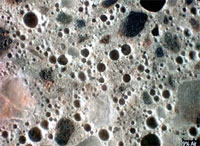
Micrograph of air-entrained concrete showing air bubblesOne of the greatest advances in concrete technology was the development of air-entrained concrete in the late 1930s. Today, air entrainment is recommended for nearly all concretes, principally to improve resistance to freezing when exposed to water and deicing chemicals. However, there are other important benefits of entrained air in both freshly mixed and hardened concrete. Air-entrained concrete contains billions of microscopic air cells. These relieve internal pressure on the concrete by providing tiny chambers for the expansion of water when it freezes.

Air-entraining admixturesAir-entrained concrete is produced through the use of air-entraining portland cement, or by introducing air-entraining admixtures under careful engineering supervision as the concrete is mixed on the job. The amount of entrained air is usually between 5 percent and 8 percent of the volume of the concrete, but may be varied as required by special conditions. The use of air-entraining agents results in concrete that is highly resistant to severe frost action and cycles of wetting and drying or freezing and thawing and has a high degree of workability and durability.


More on air-entraining admixtures.


Related Topics:
How Cement is Made
Aggregrate
Chemical Admixtures
Supplementary Cementing Materials
Placing & Finishing Concrete
Curing Concrete


Careers | Sitemap | Disclaimer | Privacy Policy | © 2009 Portland Cement Association - All Rights Reserved