In the early 1970s, experts predicted that the practical limit of ready-mixed concrete would be unlikely to exceed a compressive strength greater than 11,000 pounds square inch (psi). Over the past two decades, the development of high-strength concrete has enabled builders to easily meet and surpass this estimate. Two buildings in Seattle, Washington, contain concrete with a compressive strength of 19,000 psi.
The primary difference between high-strength concrete and normal-strength concrete relates to the compressive strength that refers to the maximum resistance of a concrete sample to applied pressure. Although there is no precise point of separation between high-strength concrete and normal-strength concrete, the American Concrete Institute defines high-strength concrete as concrete with a compressive strength greater than 6,000 psi.
Likewise, there is not a precise point of separation between high-strength concrete and ultra-high performance concrete, which has greater compressive strength than high-strength concrete and other superior properties. See ultra high-performance concrete.
Manufacture of high-strength concrete involves making optimal use of the basic ingredients that constitute normal-strength concrete. Producers of high-strength concrete know what factors affect compressive strength and know how to manipulate those factors to achieve the required strength. In addition to selecting a high-quality portland cement, producers optimize aggregates, then optimize the combination of materials by varying the proportions of cement, water, aggregates, and admixtures.
When selecting aggregates for high-strength concrete, producers consider the strength of the aggregate, the optimum size of the aggregate, the bond between the cement paste and the aggregate, and the surface characteristics of the aggregate. Any of these properties could limit the ultimate strength of high-strength concrete.
Admixtures
Pozzolans, such as fly ash and silica fume, are the most commonly used mineral admixtures in high-strength concrete. These materials impart additional strength to the concrete by reacting with portland cement hydration products to create additional C-S-H gel, the part of the paste responsible for concrete strength.
It would be difficult to produce high-strength concrete mixtures without using chemical admixtures. A common practice is to use a superplasticizer in combination with a water-reducing retarder. The superplasticizer gives the concrete adequate workability at low water-cement ratios, leading to concrete with greater strength. The water-reducing retarder slows the hydration of the cement and allows workers more time to place the concrete.
 High-strength concrete is specified where reduced weight is important or where architectural considerations call for small support elements. By carrying loads more efficiently than normal-strength concrete, high-strength concrete also reduces the total amount of material placed and lowers the overall cost of the structure.
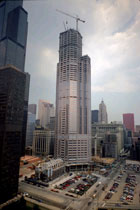
The most common use of high-strength concrete is for construction of high-rise buildings. At 969 feet, Chicago's 311 South Wacker Drive uses concrete with compressive strengths up to 12,000 psi and is one of the tallest concrete buildings in the United States.