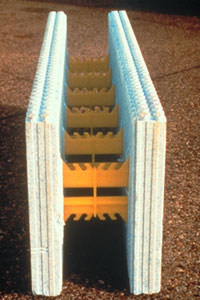
 End view of typical preassembled flat wall ICF block
Insulating concrete forms (ICFs) result in cast-in-place concrete walls that are sandwiched between two layers of insulation material. These systems are strong and energy efficient. Common applications for this method of construction are low-rise buildings, with property uses ranging from residential to commercial to industrial. Traditional finishes are applied to interior and exterior faces, so the buildings look similar to typical construction, although the walls are usually thicker.
Overview and History
Insulating concrete forms, or ICFs, are forms used to hold fresh concrete that remain in place permanently to provide insulation for the structure they enclose. Their history dates back to after World War II, when blocks of treated wood fibers held together by cement were used in Switzerland. In the 1940s and 1950s, chemical companies developed plastic foams, which by the 1960s allowed a Canadian inventor to develop a foam block that resembles today’s typical ICFs. Europeans were developing similar products around the same time.
In the 1980s and 1990s, some American companies got involved in the technology, manufacturing blocks and panels or planks. By the mid-1990s, the Insulating Concrete Form Association (ICFA) was founded to do research and promotion of the products, working toward building code acceptance. They also worked with the Portland Cement Association to build awareness of this type of construction. Although there were some obstacles—costs could be greater than frame construction because people didn’t understand the system, builders had to work closely to get code approval, and materials were proprietary—the number of insulating concrete forms producers grew. As a result, competition increased and costs moderated.
The new companies developed variations and innovations to distinguish one system from another. Over time, some ICF manufacturers consolidated, leading to a smaller number of larger companies. Because insulating concrete forms systems offered performance benefits like strength and energy efficiency and were initially more expensive to construct, the first target market was high end home construction. Custom home clients were willing and able to pay extra for the premium quality. As word of ICFs grew and innovations reduced manufacturing and installation costs, builders began using the forms for mid-price-range homes. Some production builders now create entire large developments using insulating concrete forms.
In the past, single family residential accounted for about 70 percent of ICF construction—versus about 30 percent for commercial or multifamily uses—but the products are suitable for all these applications, and larger buildings appear to be a growing market for ICFs. They have become popular for a variety of commercial projects including apartments or condos, hotel/motel, retail, and even movie theaters.
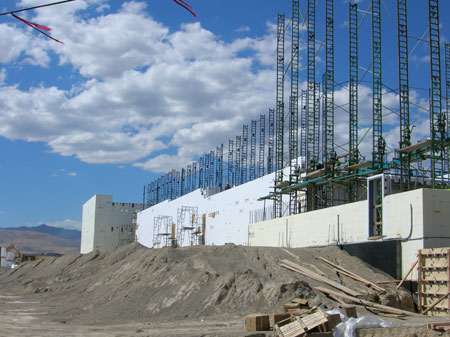
Thirty-foot tall ICF walls for multi-screen theatre project in Utah.
Advantages
Insulating concrete forms provide benefits to builders and building owners alike.
Owners appreciate:
- strong walls
- disaster resistance and safety
- mold, rot, mildew, and insect resistance (below grade can require termite protection)
- sound-blocking ability
- overall comfort
- energy efficiency and resultant cost savings
Contractors and builders like:
- fast, easy construction
- flexibility
- light weight for easy shipping and erection
- compatibility with carpenter trades
- ability to meet higher energy code mandates with less complicated construction
Sizes, Components, Configurations, Systems
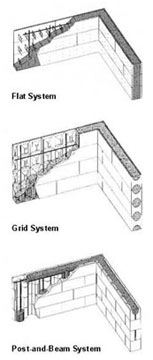
Insulating concrete forms systems can vary in their design. "Flat" systems yield a continuous thickness of concrete, like a conventionally poured wall. The wall produced by "grid" systems has a waffle pattern where the concrete is thicker at some points than others. "Post and beam" systems have just that – discrete horizontal and vertical columns of concrete that are completely encapsulated in foam insulation. Whatever their differences, all major ICF systems are engineer-designed, code-accepted, and field-proven.
The two insulating faces are separated by some type of connector or web. Large preassembled blocks stack quickly on site. Panels or planks ship more compactly, but must be assembled into formwork on the job. Foam is most often expanded polystyrene (EPS). It can be extruded polystyrene (XPS), which is stronger, but also more costly. A few products are made with recycled foam or wood fiber in a nod to green construction. The salvaged material is formed into blocks with cement, making units ideal for direct application of plaster finishes.
The ties that interconnect the two layers of insulated forming material can be plastic, metal, or additional projections of the insulation. There are advantages to each type of material, but one current trend incorporates hinges into the ties that allow pre assembled forms to fold flat for easy, less costly shipping.
The joints between individual forms can feature interlocking teeth or a tongue and groove configuration molded into the forming material, or simple butt jointed seams. Many manufacturers have developed units with universal interlocks that allow the forms to stack whether the form is flipped one way or the other. These “reversible” forms save time during placement and prevent improper alignment. Special units for corners, floors, and roof assemblies round out the product lines and improve the engineering of the system and energy efficiency of the final construction.

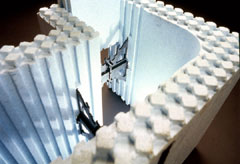
Stacking preassembled ICF formwork Example of preassembled corner blocks
Block sizes are typically on the order of 16 inches high by 48 inches long. The cavities are commonly six or eight inches wide but can be larger or smaller as needed. The foam faces are also capable of being varied, but 1-7/8- to 2-3/4-inch thickness is a usual range. So an 8-inch cavity with a two-inch foam face on either side would lead to a 12-inch formed wall. More recently some systems have developed the capability of offering thicker layers of foam to enhance performance.
After finishes are applied inside and out, typical final wall thickness is greater than one foot. This means that the depth of window and door surrounds have to be wider than what is used for traditional frame construction, with resulting deep window sills—a nice feature for homeowners or other building occupants.
Installation, Connections, Finishes
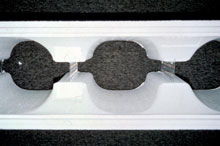
Installation of insulating concrete form systems is similar to masonry construction. Builders usually start at the corners and place a layer at a time to build up the wall. Some units, particularly those that form a “waffle” or post–and–beam concrete wall profile must be glued together or taped at the joints during assembly. Most systems today feature uniform cavities that improve flowability of the concrete, reduce the need for adhesives during stacking, resulting in flat concrete walls of consistent thickness.
Waffle grid ICF block creates variable concrete wall thickness
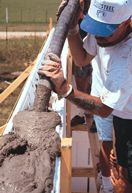 Once the forms are in place and braced and required reinforcement installed, concrete is pumped into the forms. Even with the bracing, forms need to be filled at an appropriate rate based on formwork manufacturer recommendation to prevent misalignment and blowouts. Product advancements and improved construction techniques have greatly reduced the potential for form failure. It seldom occurs when manufacturer recommendations are followed. Reinforcement in both directions maintains the wall strength. Openings for doors and windows require bucks to surround the opening, contain the fresh concrete during placement, and provide suitable material for fastening window or door frames.
Placement of concrete in ICFs with pump
Block-outs are needed when bearing pockets are required for floor or roof items. Insulating concrete form systems are compatible with concrete floors, and wood or steel floor joists. In smaller buildings, ledger assemblies for floor framing attachment mounted to the side of the formwork are common. In larger buildings or those for commercial uses, steel weld plates or bolt plates can be pre installed within the formwork so they become embedded in the fresh concrete.
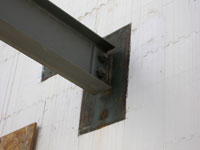
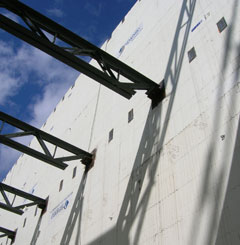
Embedded weld plates for structural steel support
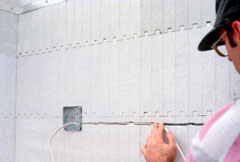 Finishes are usually attached via the flat ends of metal or plastic ties embedded in the forming material. Finishes can alternately be furred out with furring strips. Almost any type of finish can be used with these systems. Wallboard remains the most common interior finish and is the most typical means of meeting the code requirement for a 15-minute fire barrier over plastic foams surrounding living spaces. Exteriors are much more varied and depend on customer preference. Cement plasters are applied over ICFs in a manner similar to other sheathed systems.
Utilities are typically recessed into cutouts in foam after concrete has been placed
Sustainability and Energy
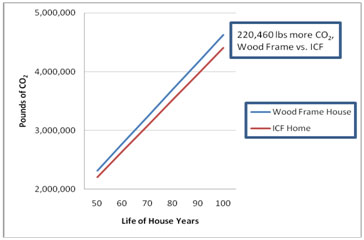
A major appeal of ICFs is the potential for reducing energy to heat and cool the building. Some estimates place the savings at 20 percent or more. The R-value for a typical Insulating concrete form is about 20. The walls can often have high air tightness 10 to 30 percent better than frame-with compatible windows, doors, and roof. As a result, assuming a 100-year service life, one single-family ICF home has the potential to save about 110 tons of CO2 compared to a traditional wood frame home. This more than offsets the CO2 associated with the production of the cement used to make the concrete. See graph below.
C02 Savings of ICF vs. Frame Home
Reference: PCA Tech Brief 12
Thermal mass is one of the reasons that Insulating concrete forms work so well to maintain a consistent temperature; insulation is the other. As the graph above demonstrates, this saves quite a bit of energy associated with heating and cooling, which not only saves money, but also provides a more comfortable interior.
Insulating concrete forms save trees because the wood frame is eliminated. Insulating concrete forms systems can also contain a decent amount of recycled materials. Concrete can be made using supplementary cementing materials like fly ash or slag to replace a portion of the cement. Aggregate can be recycled (crushed concrete) to reduce the need for virgin aggregate. Most steel for reinforcement is recycled. Some polystyrenes are recycled.
From a sustainability viewpoint, the reduced operating energy, reduction of CO2, long service life, and use of local and recycled materials make ICF construction environmentally beneficial.
Building Codes
When ICFs were first introduced to North America, codes officials were not familiar with the system, so there was a learning curve associated with approval. As reinforced concrete walls, Insulating concrete forms are quite strong. But they are built in an entirely different manner than wood frame walls and require different evaluation criteria. Many form manufacturers performed testing and prepared Evaluation Service Reports or something equivalent to that as a way to demonstrate the wall system’s integrity. Groups that generate these reports include the International Code Council Evaluation Service, Inc. and the Canadian Construction Materials Centre.
As insulating concrete forms have increased in popularity, code approval has become much simpler. For one and two family dwellings, the International Residential Code (IRC) addresses foundations and below grade walls in Section R404 and above grade walls in R611 for homes up to two stories plus a basement. For larger buildings like multi-family and commercial structures, an engineer is typically required for structural design and an Evaluation Service Report documenting approval of the ICF for the type of construction mandated for the project will often be needed to finalize approval.
ICF Projects
Sustainable Dream Home
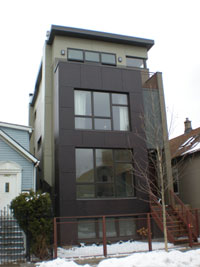 The career demands of a young married couple dictated finding a suitable city residence, one that had plenty of space and was located close to downtown Chicago. With a shorter commute, the parents would be able to spend more family time with their two children. Knowing that they planned to live there for at least 15 to 20 years, the owners recognized early in the process that they wanted the home to have energy efficiency, quality, and permanence. They determined insulating concrete form (ICF) walls provided the best performance for their needs.
Converting to Concrete Keeps Residents Safe and Warm
It may seem obvious, but if you start construction in Wisconsin in October, the weather is likely to pose a challenge. Such was the case for the Sauk County Health Care Center (SCHCC), a single-story assisted living facility located in Reedsburg, Wisconsin, 50 miles north of Madison, Wisconsin. Yet even before ground broke or the temperature started dropping, ICFs gained favor with the Sauk County Board: facility supervisors felt strongly that providing a fire-safe, disaster-resistant building was the most important thing they could do to assure the well-being of their residents.
Habitat for Humanities, Greenbuild home in Waukegan, Illinois, qualifies as LEED Platinum certified, the highest rating under the US Green Building Council's Leadership in Energy and Environmental Design for Homes.