Cement-Modified Soil (CMS) and Cement-Stabilized Subgrade (CSS) Soil
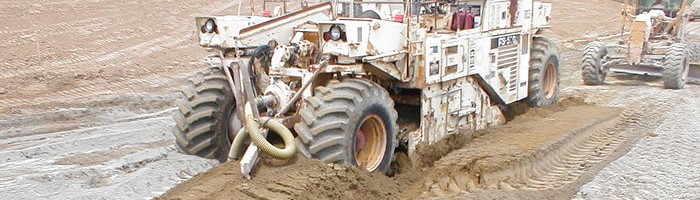
Cement-Modified Soil (CMS) and Cement-Stabilized Subgrade (CSS) soil are two distinct types of Soil-Cement applications. Both CMS and CSS improve the physical properties of native in situ soils, and both help extend the life of a pavement or structure by providing uniform support via a durable, stable, and typically non-expansive subgrade or foundation. CMS treats soils with a relatively small proportion of portland or blended cement to provide a stable working platform by reducing the plasticity and shrink/swell potential of unstable, highly plastic, wet, or expansive soils and increasing their bearing capacity. CSS not only provides all the benefits of CMS, but also substantially increases soil stiffness and strength to the point where the treatment provides measurable structural benefits.
Learn more by watching our webinar on
Cement Modification and Stabilization of Soils
CMS is a mixture of pulverized in situ soil, water, and small proportions of cement that results in an unbound or slightly bound material. The treated material is similar to a soil but has reduced plasticity and a lower susceptibility to moisture, resulting in a more workable material. The principal benefits of CMS are as follows:
- Improves the workability of subgrade soils and their ability to be used in construction
- Reduces plasticity and shrink/swell volume change potential
- Reduces moisture susceptibility and migration
- Increases the speed of construction on sites due to the reduced impact of rain
- Increases bearing capacity compared to untreated soil
- Promotes soil drying
- Provides a significant improvement to the working platform
- Uses on-site soil rather than costly removal and replacement with select fill material
- Provides a permanent soil modification (does not leach)
- Does not require any mellowing period
CSS is a compacted, engineered mixture of pulverized in situ soil, water, and moderate proportions of cement (slightly more cement than CMS) that results in a semi-bound to bound material. The treated material has structural engineering properties similar to or better than those of a granular material.
In addition to all the benefits of CMS, CSS substantially improves soil stiffness and strength to the point where the treatment provides structural benefits to pavement and building foundations. The degree of improvement depends on the quantity of cement used and the type of soil. Therefore, by the addition of varying amounts of cement, it is possible to produce cement-stabilized subgrade with a wide range of engineering properties. Typical 7-day unconfined compressive strengths (UCS) for CSS range from 100 to 300 psi (0.7 to 2.1 MPa).
CSS provides all the characteristics and principle benefits of CMS plus the following:
- Fully engineered material
- Provides a semi-bound to bound material
- Provides typical 7-day unconfined compressive strengths from 100 to 300 psi (0.7 to 2.1 MPa).
- Allows for a potential reduction in pavement or foundation thickness or increased service life
CMS and CSS are just two of several cement-specific materials. See how they and others can be used in the following applications:
PCA’s Research and Technology Department is staffed with engineers experienced in the use of cement-specific materials for a wide variety of infrastructure applications, and they are available to answer your questions. Learn more about their expertise and how to contact them here:
Meet the Experts.