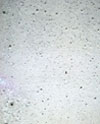
 The ever-increasing use of structural concrete as an architectural building material has catapulted quality in surface appearance to a prominent position within the concrete construction industry. One of the primary influences affecting the surface aesthetics of concrete are bugholes. Bugholes are surface voids that result from the migration of entrapped air (and to a lesser extent water) to the fresh concrete-form interface. These surface defects manifest themselves mostly in vertical surfaces.
During consolidation, the densification and subsequent volume shrinkage of the fresh concrete forces entrapped air voids and excess water out of the cementitious matrix. The water tends to migrate upward due to a density differential and become bleed water. The air bubbles, however, seek the nearest route to reach pressure equilibrium. When in a vertical form, the closest distance for the air bubbles’ migration is to the interior form surface. If these bubbles are not directed vertically to the free surface of the setting concrete, after form removal, bugholes will be present if not abundant. Bugholes are found more frequently in the upper portion of the concrete structure or at angled form surfaces as a result of additive accumulation from escaping air voids along the height of the structure. These surface voids are primarily an aesthetic problem for exposed structural concrete. However, problems do arise if the concrete surface is to be painted or if the voids reach a larger diameter (typically greater than 1 inch).
Causes
Perhaps the most influential cause of bugholes is improper vibration. Consolidation, usually through vibration, sets the air and water bubbles into motion. A proper amount of vibration sends both entrapped air and excess water to the free surface of the concrete – either vertically winding through the matrix or laterally in a direct route to the form wall. Improper vibration will either insufficiently liberate the voids or over-consolidate the concrete resulting in segregation and bleeding. (See ACI 309 for a full description of consolidation using vibration.)
Another factor that promotes bughole formation is the form material itself. Nonpermeable forms (i.e. polymer impregnated wood and steel) and the use of form-releasing agents can restrict the movement of the air voids between the concrete-form interface that is necessary for bughole reduction. It is imperative that when form-releasing agents are used, they are used according to the manufacturer’s recommendations and used only with specified form material. Mix design can also be considered a significant contributor to bughole formation. Mix designs vary widely in their use of aggregate type, size, and grading and their use of admixtures and air-entrainment. A sticky or stiff mixture that does not respond to consolidation can be directly linked to increased surface void formation.
Cure
(1) Proper consolidation. Vibration should be completed with each lift of concrete placed. As successive lifts are placed, the vibrator should penetrate the previous lift, working the entrapped air towards the form and then vertically up the sides.
(2) Permeable Forms. When impermeable forms are used, more vibration is necessary to move the air voids to the free surface of the concrete. The use of permeable forms has been shown through research to reduce bugholes significantly by allowing escaping air to move through the form to the ambient air. Choosing the proper form releasing agent in the proper amount can also improve the surface quality.
(3) Mix design. Workable, flowing mixtures are easier to place and consolidate and therefore reduce the risk of bughole formation. Concrete with an optimally graded aggregate that avoids excessive quantities of fine aggregate, properly proportioned cement content, and any admixture that provides increased flow, workability, or ease of consolidation contributes to bughole reduction. Self-consolidating concrete (SCC) is becoming increasing popular for industries (precast especially) to improve surface quality.
Bugholes as surface defects are not detrimental to structural concrete from a durability standpoint. Nevertheless, with the increased use of structural concrete in finished construction, surface quality is increasingly important. Through careful selection of materials, quality workmanship, and dutiful supervision, surface voids can be minimized.