The terms curing and drying are frequently used interchangeably with regard to the moisture condition of new concrete slabs. The following definitions clarify these terms.
Curing
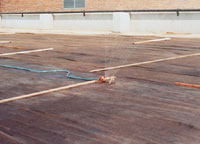
Curing of concrete is defined as providing adequate moisture, temperature, and time to allow the concrete to achieve the desired properties for its intended use. This would mean maintaining a relative humidity in the concrete of greater than 80 percent, a temperature greater than 50 degrees Fahrenheit, and for a time typically ranging from three to 14 days depending on the specific application. When these recommendations are properly specified and performed in the field, the final properties of the concrete mixture will be achieved.
Drying
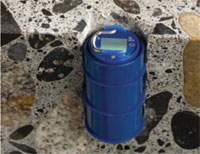
Drying of concrete is defined as providing the proper conditions to allow the concrete to achieve a moisture condition appropriate for its intended use. The moisture condition of a concrete slab is of significant importance for the application of moisture sensitive floor finishes such as vinyl composition tile, linoleum, wood flooring, and non-breathable coating like epoxy. The moisture condition is specified as a maximum relative humidity by percent or a vapor transmission rate in lb/1000 ft
2/24 hr. A typical value specified for relative humidity may be less than 75 to 80 percent to assure the successful application of the flooring materials, while a commonly specified value for vapor transmission rate may be 3 lb/1000 ft
2/24 hr.
References
Kosmatka, Steven H., Kerkhoff, Beatrix, and Panarese, William C., Design and Control of Concrete Mixtures, 15th Edition, EB001.15, 2002, 372 pg.
Kanare, Howard M., Concrete Floors and Moisture, EB119, 2008, 172 pg.