A Different Kind of Concrete
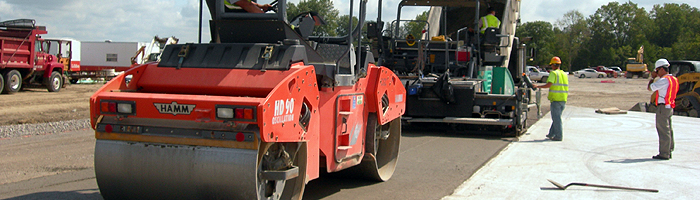
Roller-compacted concrete, or RCC, takes its name from the construction method used to build it. It's placed with conventional or high-density asphalt paving equipment,then compacted with rollers.
Roller-compacted concrete has the same basic ingredient as conventional concrete: cement, water, and aggregates, such as gravel or crushed stone.
But unlike conventional concrete, it's a drier mix—stiff enough to be compacted by vibratory rollers. Typically, RCC is constructed without joints. It needs neither forms nor finishing, nor does it contain dowels or steel reinforcing.
These characteristics make roller-compacted concrete simple, fast, and economical. View or download a RCC fact sheet.
Learn more by watching our webinars on
Roller Compacted Concrete Pavements
and
Design, Construction and Testing of RCC
Tough, Fast, Economical

These qualities have taken roller-compacted concrete from specialized applications to mainstream pavement. Today, RCC is used for any type of industrial or heavy-duty pavement. The reason is simple. RCC has the strength and performance of conventional concrete with the economy and simplicity of asphalt. Coupled with long service life and minimal maintenance, RCC's low initial cost adds up to economy and value.
Roots in Logging
RCC got its start in the Seventies, when the Canadian logging industry switched to environmentally cleaner, land-based log-sorting methods. The industry needed a strong pavement to stand up to massive loads and specialized equipment. Yet economy was equally important: log-sorting yards can span 40 acres or more. RCC met this challenge and has since expanded to other heavy-duty applications.
Today, RCC is used when strength, durability, and economy are primary needs: Port, intermodal, and military facilities; parking, storage, and staging areas; streets, intersections, and low-speed roads.
No Rutting, No Pot Holes
The high strength of RCC pavements eliminates common and costly problems traditionally associated with asphalt pavements.
RCC pavements:
-
Resist rutting
-
Span soft localized subgrades
-
Will not deform under heavy, concentrated loads
-
Do not deteriorate from spills of fuels and hydraulic fluids
-
Will not soften under high temperatures
Unique Mix, Unique Construction
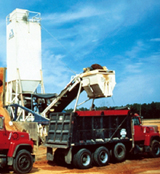
RCC owes much of its economy to high-volume, high-speed construction methods.Large-capacity mixers set the pace. Normally, RCC is blended in continuous-mixing pugmills at or near the construction site. These high-output pugmills have the mixing efficiency needed to evenly disperse the relatively small amount of water used.
Dump trucks transport the RCC and discharge it into an asphalt paver, which places the material in layers up to 10-inches thick and 42-feet wide.
Compaction is the most important stage of construction: it provides density, strength, smoothness, and surface texture. Compaction begins immediately after placement and continues until the pavement meets density requirements.
Curing ensures a strong and durable pavement. As with any type of concrete, curing makes moisture available for hydration—the chemical reaction that causes concrete to harden and gain strength. A water cure sprays or irrigates the pavement to keep it moist. A spray-on membrane can also be used to seal moisture inside.
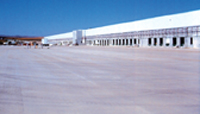
When appearance is important, joints can be saw cut into the RCC to control crack location. If economy outweighs appearance, the RCC is allowed to crack naturally.
Once cured, the pavement is ready for use. An asphalt surface is sometimes applied for greater smoothness or as a riding surface for high-speed traffic.
Economy. Performance. Versatility.
For RCC, economy was the mother of invention. The need for a low-cost, high-volume material for industrial pavements led to its development.
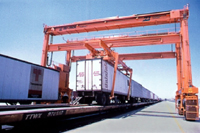
Low cost continues to draw engineers, owners, and construction managers to RCC. But today's RCC owes much of its appeal to performance: The strength to withstand heavy and specialized loads; the durability to resist freeze-thaw damage; and the versatility to take on a wide variety of paving applications. From container ports to parking lots, RCC is the right choice for tough duty.
Related Reading
For more on RCC, see the PCA guide for roller-compacted concrete pavements, Guide for Roller-Compacted Concrete Pavements, SN298.
Use of Chemical Admixtures in Roller Compacted Concrete for Pavements,
Hazaree, Chetan V.; Ceylan, Halil; Taylor, Peter; Gopalakrishnan, Kasthurirangan;Wang, Kejin, and Bektas, Fatih, SN3243, Portland Cement Association, 2010.
This research attempts to resolve some of the problems in using roller compacted concrete. Ten most widely used chemical admixtures were tested in a typical RCC mixture. It is observed that each admixture offers distinct benefits and improves different properties of fresh RCC including changing the setting behavior and finishibility. A set of recommendations is offered along with precautions for using these admixtures individually. It is anticipated that this work will lead to the better characterization of different properties of RCC and use of chemical admixtures with greater confidence.
View graph on RCC pavement features and benefits.
For more information visit rccpavementcouncil.org