
Blended Cement in Concrete: Technical Guidance and Proven Applications
Blended cements are no longer an emerging concept. They are a dominant and evolving reality in concrete construction. A recent panel session at the 2026 AGC Convention brought together industry leaders from the American Cement Association (ACA), National Ready Mixed Concrete Association (NRMCA), and members of the American Society of Concrete Contractors (ASCC) from Barton Malow Company and DPR Construction. The session addressed practical insights covering industry trends, field applications, and best practices for the successful adoption of blended cements in construction projects.
This article distills those insights into practical guidance for contractors responsible for delivering consistent results under changing material conditions.
Blended Cements: What Contractors Need to Know
Blended cements combine two or more fine materials, including portland cement, ground limestone, and supplementary cementitious materials (SCMs) such as slag, coal ash, or calcined clay. Decades of research and collaboration have evolved specifications that address contemporary blended cement within ASTM C595 to now include:
- Type IL (portland-limestone cement): 5% to 15% limestone interground or blended with portland cement clinker.
- Type IS (portland blast-furnace slag cement): Incorporates blast furnace slag.
- Type IP (portland-pozzolan cement): Includes coal ash or other natural pozzolans such as calcined clay or silica fume.
- Type IT (ternary blended cement): Multiple SCMs combined for performance synergy
As of August 2025, blended cements account for roughly two-thirds of the U.S. cement market, driven largely by sustainability goals (Figure 1). By incorporating limestone and SCMs, blended cements reduce emissions and the demand for natural resources.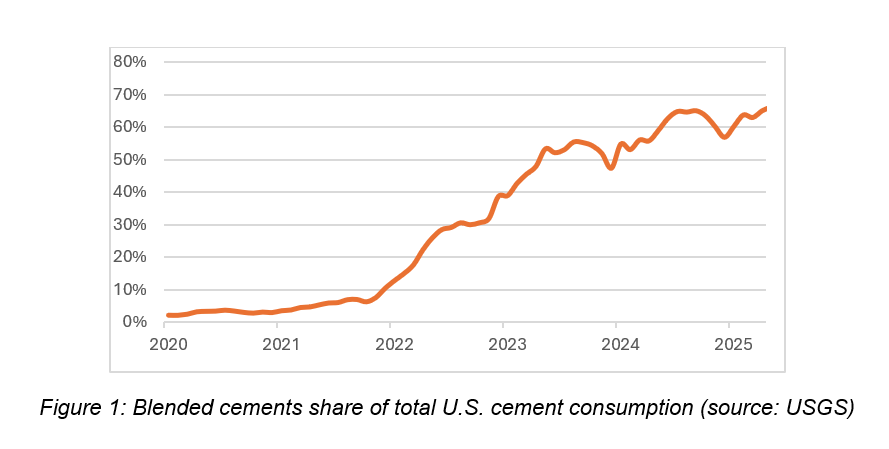
Contractors should keep in mind that cement types vary across projects and regions, so every mixture must be evaluated in its specific context.
Vetting Blended Cement: A Practical Workflow
Adopting a new cementitious system requires a structured evaluation process. The NRMCA industry-recommended approach (NRMCA TIP26) follows a progression:
- Start with Supplier Data
Request and review:
- Certification reports (chemistry, fineness, loss on ignition)
- Historical variability data
- Material consistency over time
Track this data across deliveries. Small shifts can affect performance.
- Supplement as Needed, with Further Targeted Testing
When needed, conduct additional analysis:
- Particle-size distribution
- X-ray fluorescence/diffraction (chemical and phase composition)
- Calorimetry (heat evolution and reaction rate)
This is especially helpful when troubleshooting issues such as set time variability or admixture incompatibility.
- Use Mortar Testing as a Screening Tool
Mortar tests provide early trends but are not definitive. They can help identify:
- Relative strength development
- Workability tendencies
- Validate with Concrete Testing
This is where contractor-relevant performance is confirmed:
- Water demand and slump retention
- Bleeding characteristics
- Air content and admixture response
- Set times and finishing window
- Strength gain (early and long-term)
- Shrinkage behavior
Changes in bleeding and setting time are common with blended cements and directly impact finishing operations.
- Confirm in the Field
Lab results must be verified under actual placement conditions:
- Does the mix behave the same in real weather conditions?
- Are finishing timelines accurate?
- Is strength gain tracking as expected?
Field validation is where risk is either mitigated or exposed.
Mockups: A Risk-Control Tool
Across all panelists, one message was repeated: Mockups are essential to the success of a project.
Effective mockups allow contractors to:
- Dial-in finishing timing
- Adjust crew size and sequencing
- Evaluate bleed and set behavior
- Test admixture strategies
- Align expectations with owners and designers
Well-executed mockups often reveal that perceived “problems” (such as slower set times) can be managed—or even leveraged—for productivity gains.
Common Challenges (and How to Manage Them)
Cementing materials and concrete mixture behaviors canbe significantly different across regions and projects. These changes can be managed with the right level of planning, testing, and communication. Understanding the most common issues—and how to address them—can help contractors maintain confidence and consistency in the field.
Some challenges may include:
- Variability
Changes in cement composition can affect:
- Setting time
- Bleeding
- Strength development
Mitigation: Track supplier data and require change notifications.
- Admixture Compatibility
Blended systems can interact differently with chemical admixtures.
Mitigation:
- Test admixtures during mockups
- Follow supplier recommendations first
- Adjust dosages, and possibly sequencing- not just product type
- Strength Development Concerns. Early strength variability is a common issue, particularly in new markets.
Mitigation:
- Review strength curves (beyond 28-day results)
- Use calorimetry and field data when available
- Avoid relying solely on historical assumptions
- Workforce Resistance. Crews often resist new materials due to uncertainty.
Mitigation:
- Communicate clearly what is changing and what is not
- Use hands-on mockups to build confidence
- Leverage experienced local crews when entering new markets
Aligning Expectations and Practices for Blended Cement Performance
Blended cements do not inherently reduce performance; however, they will influence the timing and behavior of concrete. Understanding this distinction is critical. When contractors adjust their workflows to account for these differences—particularly around setting time, finishing, and curing—they can achieve outcomes that meet or exceed project expectations.
This shift in understanding is closely tied to how projects are specified. Traditional prescriptive specifications can limit the benefits of blended cements by constraining mixture options. In contrast, performance-based specifications—such as those aligned with AASHTO R 101—focus on key outcomes like strength, durability, shrinkage, permeability, and workability. For contractors, this approach offers greater flexibility to meet project requirements while also optimizing cost and constructability.
Preconstruction and pre-placement meetings play a central role in setting the project up for success. These discussions should go beyond routine coordination and serve as the forum for aligning expectations on performance and finish, clarifying how the mixture is expected to behave, coordinating placement and curing strategies, and establishing clear communication protocols if adjustments are needed. When expectations are not clearly communicated upfront, the risk of project challenges increases significantly.
For more information on blended cements, visit www.blendedcements.com.
Sidebar: Actionable Takeaways for Contractors
- Treat every new blend as a new material, even if the label is familiar.
- Require and review supplier data consistently.
- Invest in mockups. They pay for themselves.
- Adjust finishing practices based on bleed and set behavior.
- Push for performance-based specifications where possible.
- Communicate early, often, and clearly across all stakeholders
- Leverage industry resources and peer experience.
About the Authors:
Michelle L. Wilson, FACI, is Senior Director of Concrete Technology and Industry Outreach at the American Cement Association. She is the primary author of Design and Control of Concrete Mixtures and has over 25 years of experience relating to concrete materials, specifications, performance, durability, troubleshooting and repair. Wilson served on the Board of Direction of American Concrete Institute and is past chair of 301 Specifications for Concrete Construction. She is a Fellow of the Institute and was awarded the Arthur R. Anderson Medal for her contributions to the advancement of knowledge of concrete. She is also an Honorary Member of ASTM International Committee C09 Concrete and Concrete Aggregates.
Brian M. Killingsworth, P.E., is Executive Vice President, Strategic Operations at the National Ready Mixed Concrete Association. In this role, Brian leads NRMCA’s Engineering, Operations, and Concrete Promotion and Code, aligning member services with the organization’s mission and strategic plan. A graduate of Texas A&M University with B.S. and M.S. degrees in Civil Engineering, he spent nearly two decades in private consulting supporting research, design, asset management, and forensic evaluation projects for public-sector clients.
Tom Binkowski is Senior Trade Director for Barton Malow Company. Tom has more than 40 years’ experience in concrete operations and is responsible for all concrete operations on the union contractor’s projects. He sits on the ASCC CPC board, is an ASCC Technical Committee member, and is an ACI 302 slab on grade voting member. He oversaw the current world record for steel fiber-reinforced slab, a 250,000-SF pour completed in just 18 hours for General Motors in Arlington, Texas.
Joey Schneider is a southeast concrete leader with 26+ years of leadership and over two decades in the craft. He’s placed, finished, and led his way from concrete laborer to industry leader, completing his first data center project in 2013 and guiding teams to deliver 29 more across seven campuses since 2020 with over than 15 million square feet of slab‑on‑grade. A graduate of Miami University with a B.S. in Business, Organizational Leadership, Joey blends technical expertise with a people‑first approach.