Buildings are designed to resist loads prescribed by building codes. These include gravity loads such as building weight and live load, wind, seismic loads, and fire. Depending on the building type, configuration, and location other loads such as water pressure, snow, soil pressure, rain, and temperature effect may also need to be accounted for.
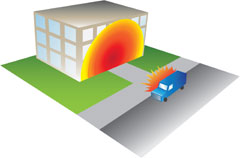
Explosive blast, whether accidentally or intentionally caused, is another force that needs to be taken into account. Blast generally results in a high-amplitude impulse loading which lasts for a very short period of time and produces high pressure loading. The loading in many situations is local in the sense that only those elements closest to the blast may be directly impacted. Elements far from the blast site may experience little or no direct impact due to sharp attenuation (dissipation) of blast energy with distance. The forces experienced by structural components depend on the size, geometry and proximity of the explosion. For decades, blast-resistant design was applied almost exclusively to military facilities. Since the 1995 Oklahoma City bombing, however, concern for blast resistance has spread to other sectors as well.
Explosive or other accidents may cause damage to one or limited number of structural members leading to additional collapse of adjoining members, which in turn leads to additional collapse. This sequence of failure is known as progressive collapse. Following the Alfred P. Murrah Federal Building bombing in 1995, an executive order was issued by the federal government to establish construction standards for federal buildings subject to terrorist attack.
In response to this executive order, several committees and departments developed criteria for blast-resistance building design The Interagency Security Committee (ISC) was organized to issued the
Security Design Criteria for New Federal Office Buildings and Major Modernization Projects. The General Services Administration published
Progressive Collapse Analysis and Design Guidelines for New Federal Office Buildings and Major Modernization Project in 2000 and revised it in June 2003 to meet the progressive collapse requirements of the ISC. The U.S. Department of Defense (DoD) created the Unified Facilities Criteria (UFC) system to provide guidelines for design and construction of all DoD construction projects and introduced design for progressive collapse mitigation and prevention. The general planning, layout, and discussions on different level of protection for building are discussed in the DoD document; UFC 4010-01
DoD Minimum Antiterrorism Standard for Buildings. Detailed design for progressive collapse is introduced in UFC 4-023-03
Design of Buildings to Resist Progressive Collapse. The main purpose of structural design for building is to protect their inhabitants and contents from harm. To achieve this purpose all possible loads and hazard scenarios during the life time of the building should be considered. Every building is unique, not every building faces the same risks, and not every potential threat justifies the same precautions, but it is important to evaluate all potential hazard and risks and take appropriate precautions to promote the safety and security of buildings and the people who occupy them.
Concrete and Explosive Blast
Concrete has many favorable attributes with regard to blast response. Blast load durations are very short term compared to other extreme structural loads, and are often shorter than the natural period of many structural elements. Because of this blast waves do not excite the mass of the structure in the same way as longer period, cyclic loading. The mass of concrete structures provides a direct resistance to the blast wave. The inherent continuity of reinforced concrete structures allows properly detailed structures to respond in a predictable manner, and also provides a degree of reserve capacity with the potential to develop alternate load path and resistance mechanisms under extreme conditions. Properly detailed concrete structures have substantial ductility and energy dissipation characteristics, which are necessary to resist blast effect. Also, the potential for fires from explosions is very high, both from the explosion itself as well as from secondary fires caused by damage. The inherent fire resistance of concrete is attractive, particularly due to the potential of having a compromised fire suppression system following a blast event.
Publications
 Blast Resistant Design Guide for Reinforced Concrete Structures, EB090
This guide, which includes a foreword by Dr. Gene Corley, provides structural engineers with a practical treatment of the design of cast-in-place reinforced concrete structures to resist the effects of blast loads. Readers will be able to understand the principles of blast-resistant design, determine the kind and degree of resistance a structure needs, and specify the materials and details required to provide it. Guidelines are provided for detailing requirements for blast resistance and detailing philosophy and reinforcement splicing are introduced for columns, beams, slabs, walls and joints. It includes a final chapter devoted to design methods that can protect structures against progressive collapse.
 PCA Notes on ACI 318-08 Building Code, EB708
The 11th edition of this classic PCA resource has been updated to reflect code changes introduced in the latest version of Building Code Requirements for Structural Concrete, ACI 318-11. These notes will help users apply code provisions related to the design and construction of concrete structures. Each chapter of the manual starts with a description of the latest code changes. Emphasis is placed on “how-to-use” the code. Numerous design examples illustrate application of the code provisions.
 Seismic Detailing of Concrete Buildings, SP382
This publication contains a comprehensive summary of the seismic detailing requirements contained in Building Code Requirements for Structural Concrete (318-05) and Commentary (318R-05), which is adopted by reference in the 2006 International Building Code. A supplemental CD is included with reinforcement details for beams, columns, two-way slabs, walls and foundations. International Building Code. A supplemental CD is included with reinforcement details for beams, columns, two-way slabs, walls and foundations.
 Simplified Design: Reinforced Concrete Buildings, EB204
This new, fourth edition presents practicing engineers with timesaving analysis, design, and detailing methods of primary framing members of a reinforced concrete building. Revised and updated to ACI 318-11, it incorporates seismic and wind load provisions to comply with the International Building Code (2009 IBC). All equations, design aids, graphs, and code requirements have been updated to the current codes. Expanded illustrations of the theory and fundamentals and new timesaving design aids were added to include a wider range of concrete strengths. Also contains a new chapter on sustainable design.
Helpful Articles
U.S. – GSA Progressive Collapse Design Guidelines Applied to Concrete Moment-Resisting Frame Buildings Originally published in 2004 ASCE/SEI Structures Congress proceedings, Nashville, Tennessee.
Capacity of Joints to Resist Impact Loads in Concrete Moment-Resisting Frame Buildings
Originally published in 2007 ASCE/SEI Structures Congress proceedings, Long Beach, California.
Fire and Concrete Structures
This paper provides structural engineers with a summary of the complex behavior of structures in fire and the simplified techniques which have been used successfully for many years to design concrete structures to resist the effects of severe fires. 2008 ASCE/SEI.
New Engineers Under Fire, "Concrete International," July 2005, 4 pages.
This article takes an introductory look at how fire affects concrete and masonry structures, as well as how to determine if a structure meets building code requirements for building endurance. Member sizes are not simply functions of load, span, and formwork costs, but they can also be functions of requirements for fire safety. Fire considerations must, therefore, be part of the preliminary design stages.