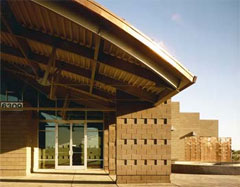
 Concrete masonry systems (CMS) are familiar to most people because they have been used for such a long time. All types of low-rise buildings are made with these materials, from residential to educational to commercial and industrial. The tough exterior of exposed units provides a durable finish in demanding environments. And architects often prefer the aesthetic appeal of masonry to many other finishes.
Concrete masonry units are manufactured from very dry, stiff concrete mixtures. The “no-slump” or “low-slump” material is placed into molds, vibrated and compacted, and demolded quickly. Units are stiff enough to hold their shape as they enter the curing chamber. Afterwards, they are palletized and readied for shipping. Factories through the country manufactured concrete masonry units, adding to local economies and meeting sustainable criteria for availability.
Overview and History
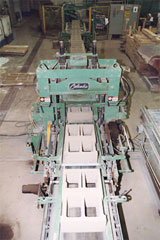 During the past 100 years, manufacture of concrete masonry units (CMU) transitioned from a hand cast process to a highly automated one. Single molds compacted by hand gave way to ganged molds that travel on assembly lines in high-tech manufacturing facilities. These changes have also led to excellent quality control and uniformity of units.
Concrete masonry units are manufactured from very dry, stiff concrete mixtures. The “no-slump” or “low-slump” material is placed into molds, vibrated and compacted, and demolded quickly. Units are stiff enough to hold their shape as they enter the curing chamber. Afterwards, they are palletized and readied for shipping. They are manufactured throughout the country, adding to local economies and meeting sustainable criteria for availability.
Advantages
It’s hard to determine which attribute of CMU is its best. It may vary from one project to another. Certainly, the fact that these are non-combustible is very important. They are durable and long lasting, can provide an attractive finish, can be reinforced as needed to meet demanding structural applications, can contain recycled materials, do not require painting or other treatment, contain no volatile organic compounds (VOCs) or other potentially harmful offgassing materials, and provide thermal mass to maintain uniform temperatures.
From a construction perspective, a nice feature of masonry is that it can be built without much space for staging the construction. On constricted sites or between buildings, this is helpful. It may be more labor intensive than some other concrete construction, but materials are literally available off the shelf and this is advantageous because there is less chance for time delays waiting for special orders.
Sizes, Components, Configurations, Systems
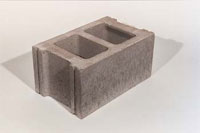 CMU are modular. The most common size is a nominal 8-by-8-by-16- inches. Door and window openings are positioned to minimize cutting of units. Walls that contain one vertical layer of units are called single wythe and two layers are double wythe. It is most common to build single- or double-wythe walls. When wythes are separated by a continuous vertical space, the assembly is known as a cavity wall. Units are held together by mortar.
Reinforcement is placed into horizontal and vertical cavities as needed, with grout placed around it. This helps walls to carry loads and resist other forces acting on them.
Insulation may be added to interior or exterior faces, between wythes, or inside special unit cavities. The benefit of keeping the insulation inside the wall is that the masonry faces are quite durable. Other accessories may be needed to promote proper drainage, attach finishes, and otherwise complete the wall.
Installation, Connections, Finishes
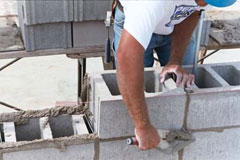 Masonry is laid by skilled masons. They place mortar between units to tie them together. Masonry requires little machinery for placement: a mason and a trowel are the two main things necessary.
Walls, within and between them, are tied together with reinforcement. Joint reinforcement may be used along mortar joints to help control cracking in the wall. Anchors, plates, and other items that are common with other construction are used in masonry, too.
Finishes are often simplified when using masonry. It can be sealed or painted. It can be plastered for aesthetics and improved moisture resistance. But in many cases, it is left exposed. This can be done with plain or architectural units. Some finishes are made specifically for durability in moist exposures, like locker rooms, pools, or kitchen or laundry facilities. These masonry surfaces are often brightly colored to provide a hard, attractive finish.
Sustainability and Energy
Concrete masonry is sustainable for a number of reasons. It can contain recycled materials. It is made from local materials and usually shipped short distances to a project. These aspects often contribute toward credits in green rating systems.
Masonry construction is energy efficient, providing thermal mass to help moderate temperature in buildings. Lighter weight units are made with lightweight aggregate to help provide added thermal resistance. In addition, masonry walls can be insulated in a wide variety of ways.
Building Codes
Masonry has its own code requirements. A Code and Specification jointly published by The Masonry Society, American Concrete Institute, and the Structural Engineering Institute of the American Society of Civil Engineers are written as legal documents so that they may be adopted by reference in general building codes. They address materials, labor, design, and construction.
Concrete Masonry Projects
Concrete Masonry Affords Opportunities for Building Green on Infill Sites
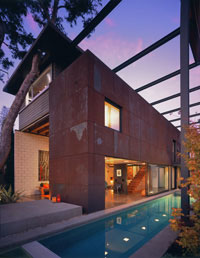 Infill sites are neglected public spaces and clusters of vacant or nearly-empty buildings and land in either urban or suburban communities. Concrete masonry units (CMU) are an ideal building material for infill projects because there is often no adjacent space available for large equipment or staging areas. And because these projects tend to be tall, thin, and closely situated to property lines, the inherent strength, fire resistance, and noise abatement of CMUs provide an economical solution.
One recent infill project is an eco-friendly residence in southern California. It has a small carbon footprint in balance with lifestyle common in the area, but functions as a high-performance building.
Twenhofel Middle School: Benefits Add Up in Classroom Settings
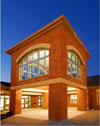 Located near Cincinnati, Twenhofel Middle School was one of Kentucky’s first schools to incorporate sustainable building principles and energy conservation measures. In 2004, these ideas were not necessarily revolutionary, but neither had they been the focus of school administrators prior to that time. The excellent results achieved with Twenhofel have only increased the district’s efforts to do more of the same.
The backbone of this school is concrete masonry. Generally, one reason concrete masonry has been so popular in schools is its durability. Hard surfaces stand up to wear and tear that is so common in schools and other high usage areas. The walls of Twenhofel are double-wythe masonry, consisting of CMU backup and an exterior clay brick finish with 1½ inches of insulation in between for an R-15 rating. Like most walls with thermal mass, these masonry sections perform better than their apparent R-value. This construction, along with many other energy-efficient features, results in 31 percent less energy usage than an average Kentucky school. That’s good for the environment and is a direct savings to the school’s bottom line.
Beyond the energy efficient envelope, this school is designed with a whole array of features that focus on performance. There is a geothermal HVAC system, increased glazing to improve daylighting and minimize artificial lighting, collection of solar power via a photovoltaic system, and reduced water usage.
Benefits of building high performance schools include:
- Better student performance
- Increased average daily attendance
- Increased teacher satisfaction and retention
- Reduced energy and operating costs
- Positive influence on the environment
As one of the first schools in Kentucky to accomplish these achievements, Twenhofel has been a model and a learning tool. The building itself has monitors and transparent panels as a way to place a focus on building operations and teach about sustainability and energy efficient design and operation. The ability to use the facility as a teaching tool encourages conservation among occupants, teachers, administrators, and students alike.
Resources
There are many helpful tools for designing and building with masonry. The National Concrete Masonry Association has online technical publication known as TEK sheets and details for concrete masonry.
The Brick Industry Association also publishes technical notes for clay masonry (brick). A number of other groups such as The Masonry Society publish guides and other documents used for the design and construction of masonry.