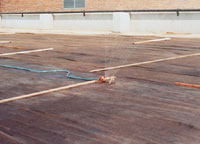
 Curing plays an important role on strength development and durability of concrete. Curing takes place immediately after concrete placing and finishing, and involves maintenance of desired moisture and temperature conditions, both at depth and near the surface, for extended periods of time. Properly cured concrete has an adequate amount of moisture for continued hydration and development of strength, volume stability, resistance to freezing and thawing, and abrasion and scaling resistance.
The length of adequate curing time is dependent on the following factors:
- Mixture proportions
- Specified strength
- Size and shape of concrete member
- Ambient weather conditions
- Future exposure conditions
Slabs on ground (e.g. pavements, sidewalks, parking lots, driveways, floors, canal linings) and structural concrete (e.g. bridge decks, piers, columns, beams, slabs, small footings, cast-in-place walls, retaining walls) require a minimum curing period of seven days for ambient temperatures above 40 degrees Fahrenheit1.
American Concrete Institute (ACI) Committee 301 recommends a minimum curing period corresponding to concrete attaining 70 percent of the specified compressive strength2. The often specified seven-day curing commonly corresponds to approximately 70 percent of the specified compressive strengths. The 70 percent strength level can be reached sooner when concrete cures at higher temperatures or when certain cement/admixture combinations are used. Similarly, longer time may be needed for different material combinations and/or lower curing temperatures. For this reason, ACI Committee 308 recommends the following minimum curing periods3:
- ASTM C 150 Type I cement seven days
- ASTM C 150 Type II cement ten days
- ASTM C 150 Type III cement three days
- ASTM C 150 Type IV or V cement 14 days
- ASTM C 595, C 845, C 1157 cements variable
Effect of curing duration on compressive strength development is presented in Figure 1.
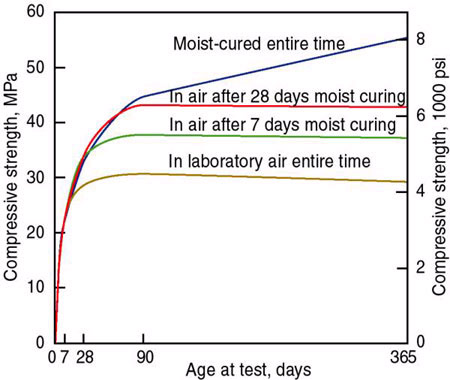
Figure 1. Moist Curing Time and Compressive Strength Gain
Higher curing temperatures promote an early strength gain in concrete but may decrease its 28-day strength. Effect of curing temperature on compressive strength development is presented in Figure 2.
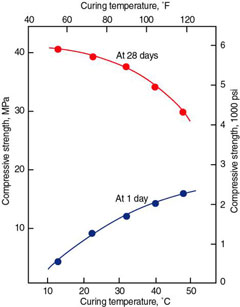
Figure 2. Effect of Curing Temperature on Compressive Strength
There are three main functions of curing:
1) Maintaining mixing water in concrete during the early hardening process
Ponding and immersion
Ponding is typically used to cure flat surfaces on smaller jobs. Care should be taken to maintain curing water temperature at not more than 20 degrees Fahrenheit cooler than the concrete to prevent cracking due to thermal stresses. Immersion is mainly used in the laboratory for curing concrete test specimens.
Spraying and fogging
Spraying and fogging are used when the ambient temperatures are well above freezing and the humidity is low. Fogging can minimize plastic shrinkage cracking until the concrete attains final set.
Saturated wet coverings
Wet coverings saturated with water should be used after concrete has hardened enough to prevent surface damage. They should be kept constantly wet.
Left in Place Forms
Left in place forms usually provide satisfactory protection against moisture loss for formed concrete surfaces. The forms are usually left in place as long as the construction schedule allows. If the forms are made of wood, they should be kept moist, especially during hot, dry weather.
2) Reducing the loss of mixing water from the surface of the concrete
Covering concrete with impervious paper or plastic sheets
Impervious paper and plastic sheets can be applied on thoroughly wetted concrete. The concrete surface should be hard enough to prevent surface damage from placement activities.
Applying membrane-forming curing compounds
Membrane-forming curing compounds are used to retard or reduce evaporation of moisture from concrete. They can be clear or translucent and white pigmented. White-pigmented compounds are recommended for hot and sunny weather conditions to reflect solar radiation. Curing compounds should be applied immediately after final finishing. Curing compound shall comply with ASTM C3094 or ASTM C13155.
3) Accelerating strength gain using heat and additional moisture
Live steam
Live steam at atmospheric pressure and high-pressure steam in autoclaves are the two methods of steam curing. Steam temperature for live steam at atmospheric pressure should be kept at about 140 degrees Fahrenheit or less until the desired concrete strength is achieved.
Heating coils
Heating coils are usually used as embedded elements near the surface of concrete elements. Their purpose is to protect concrete from freezing during cold weather concreting.
Electrical heated forms or pads
Electrical heated forms or pads are primarily used by precast concrete producers.
Concrete blankets
Concrete insulation blankets are used to cover and insulate concrete surfaces subjected to freezing temperatures during the curing period. The concrete should be hard enough to prevent surface damage when covering with concrete blankets.
Other forms of curing include internal moist curing with lightweight aggregates or absorbent polymer particles. For mass concrete elements (usually thicker than 3 feet), a thermal control plan is usually developed to help control thermal stresses. Additional information can be found in ACI Committee 308 report Guide to Curing Concrete3. For specialty concretes, it is recommended to refer to other ACI reports as follows:
- Refractory concrete ACI 547.1R
- Refractory concrete ACI 547.1R
- Insulating concrete ACI 523.1R
- Expansive cement concrete ACI 223
- Roller-compacted concrete ACI 207.5R
- Architectural concrete ACI 303R
- Shotcrete ACI 506.2
- Fiber-reinforced concrete ACI 544.3R
- Vertical slipform construction ACI 313
Curing in either cold or hot weather requires additional attention. In cold weather, some of the procedures include heated enclosures, evaporation reducers, curing compounds, and insulating blankets. The temperature of fresh concrete shall be above 50 degrees Fahrenheit. The curing period for cold weather concrete is longer than the standard period due to reduced rate of strength gain. Compressive strength of concrete cured and maintained at 50 degrees Fahrenheit is expected to gain strength half as quickly as concrete cured at 73 degrees Fahrenheit. In hot weather, curing and protection are critical due to rapid moisture loss from fresh concrete. The curing actually starts before concrete is placed by wetting substrate surfaces with water. Sunscreens, windscreens, fogging, and evaporation retardants can be used for hot weather concrete placements. Since concrete strength gain in hot weather is faster, curing period may be reduced. Additional information can be found in ACI 306.1, Standard Specification for Cold Weather Concreting, ACI 306R, Cold Weather Concreting, ACI 305.1, Specification for Hot Weather Concreting, and ACI 305R, Hot Weather Concreting
Curing Concrete Test Specimens
Curing of concrete test specimens is usually different from concrete placed during construction. American Society for Testing and Materials (ASTM) has developed two standards for making and curing concrete specimens. ASTM C192
6 is intended for laboratory samples while ASTM C31
7 is intended for field samples. Both documents provide standardized requirements for making, curing, protecting, and transporting concrete test specimens under field or laboratory conditions, respectively.
ASTM C192 provides procedures for evaluation of different mixtures in laboratory conditions. It is usually used in the initial stage of the project, or for research purposes.
ASTM C31 is used for acceptance testing and can also be used as a decision tool for form or shoring removal. Depending on its intended purpose, the standard defines two curing regimes: standard curing for acceptance testing and field curing for form/shoring removal. Variation in standard curing of test specimens can dramatically affect measured concrete properties. According to the National Ready Mix Concrete Association
8 (NRMCA), strength for concrete air cured for one day followed by 27 days moist cured will be approximately 8 percent lower than for concrete moist cured for the entire period. The strength reduction is 11 percent and 18 percent for concrete specimens initially cured in air for three days and seven days, respectively. For the same air/moist curing combinations, but 100 degrees Fahrenheit air curing temperature, the 28-day strength will be approximately 11 percent, 22 percent, and 26 percent lower, respectively.
References
Steve Kosmatka et al, Design and Control of Concrete Mixtures, 15th Edition, EB001, PCA Engineering Bulletin EB 001, Portland Cement Association , Skokie, IL 2002
Specifications for Structural Concrete, ACI 301 (www.concrete.org)
Guide to Curing Concrete, ACI 308R-01 (www.concrete.org)
ASTM C309, Standard Specification for Liquid Membrane-Forming Compounds for Curing Concrete (www.astm.org)
ASTM C1315, Standard Specification for Liquid Membrane-Forming Compounds Having Special Properties for Curing and Sealing Concrete (www.astm.org)
ASTM C192 / C192M, Standard Practice for Making and Curing Concrete Test Specimens in the Laboratory (www.astm.org)
ASTM C31 / C31M, Standard Practice for Making and Curing Concrete Test Specimens in the Field (www.astm.org)