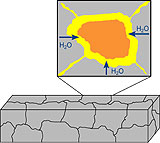
In most concrete, aggregates are more or less chemically inert. However, some aggregates react with the alkali hydroxides in concrete, causing expansion and cracking over a period of many years. This alkali-aggregate reaction has two forms: alkali-silica reaction (ASR) and alkali-carbonate reaction (ACR).
 Alkali-silica reaction (ASR) is of more concern because aggregates containing reactive silica materials are more common. In ASR, aggregates containing certain forms of silica will react with alkali hydroxide in concrete to form a gel that swells as it adsorbs water from the surrounding cement paste or the environment. These gels can induce enough expansive pressure to damage concrete.
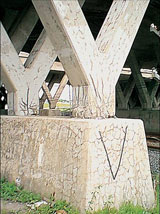
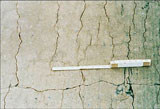
Typical indicators of ASR are random map cracking and, in advanced cases, closed joints and attendant spalled concrete. Cracking usually appears in areas with a frequent supply of moisture, such as close to the waterline in piers, near the ground behind retaining walls, near joints and free edges in pavements, or in piers or columns subject to wicking action. Petrographic examination can conclusively identify ASR.
Alkali-silica reaction can be controlled using certain supplementary cementitious materials. In-proper proportions, silica fume, fly ash, and ground granulated blast-furnace slag have significantly reduced or eliminated expansion due to alkali-silica reactivity. In addition, lithium compounds have been used to reduce ASR. Although potentially reactive aggregates exist throughout North America, alkali-silica reaction distress in concrete is not that common because of the measures taken to control it. It is also important to note that not all ASR gel reactions produce destructive swelling.
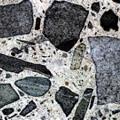 Alkali-carbonate reaction (ACR) is observed with certain dolomitic rocks. Dedolomitization, the breaking down of dolomite, is normally associated with expansion. This reaction and subsequent crystallization of brucite may cause considerable expansion. The deterioration caused by alkali-carbonate reactions is similar to that caused by ASR; however, ACR is relatively rare because aggregates susceptible to this phenomenon are less common and are usually unsuitable for use in concrete for other reasons. Aggregates susceptible to ACR tend to have a characteristic texture that can be identified by petrographers. Unlike alkali carbonate reaction, the use of supplementary cementing materials does not prevent deleterious expansion due to ACR. It is recommended that ACR susceptible aggregates not be used in concrete.
Prevention of Alkali-Silica Reaction in New Concrete
Follow the steps in the flowchart below to determine if potential for ASR exists and to select materials to control it. For more information move your mouse over the individual flowchart boxes.
See flowchart Additional Resources
Find more at Federal Highway Administration Alkali-Silica Reactivity Program.