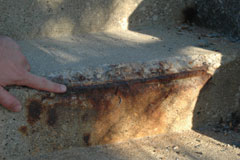
Corrosion of this rebar caused spalling on a concrete step.
The corrosion of reinforcing steel can be a problem in concrete structures. Corrosion of steel produces hydrated iron oxide or rust, which is very expansive. This expansion builds up internal pressure until the concrete fails in the form of spalling. This is a leading cause of concrete deterioration and numerous studies have been performed to prevent corrosion of reinforcing steel.
Specifying Durable Concrete
Specifying a durable concrete begins with identifying exposure conditions. To what deterioration mechanisms will the concrete be exposed? Three exposure classes relating to corrosion protection of reinforcement are defined in ACI 318: not applicable (C0), moderate (C1), and severe (C2). The most common cause of steel corrosion is chloride ingress (see
Corrosion of Embedded Metals). Any reinforced concrete exposed to moisture and external chlorides, be it from seawater or deicer salts, is considered to be in a severe corrosion environment. This condition requires a minimum design strength of 5,000 psi and a maximum w/cm of 0.40. In addition, supplementary cementitious material use is limited in any environment where concrete will be exposed to both deicer salts (C2) and very severe freezing and thawing (exposure class F3). Current limitations include: slag – a maximum of 50 percent, fly ash – a maximum of 25 percent, and silica fume – a maximum of 10 percent. Additionally, mixtures containing three or more cementitious or pozzolanic materials (ternary, quaternary, and so on) are limited to no more than 50 percent cementitious materials by mass when slag is included or 35 percent when slag is not included.
Performance specifications may be used in lieu of prescriptive mixture proportions. Caldarone (2005) provides a guide specification that allows for performance-based acceptance of concrete. With regards to corrosion resistance, the specifier indicates the method of curing and duration of aging of test specimens and the maximum charge allowed using ASTM C1202 (AASHTO T 277),
Standard Test Method for Electrical Indication of Concrete’s Ability to Resist Chloride Ion Penetration. The resistance to chloride ion penetration is used, because, as mentioned earlier, chloride ingress is the most common cause of reinforcing steel corrosion. Other performance requirements can be specified, such as scaling resistance, strength, and freeze/thaw durability.
Testing for Corrosion Resistance
The first line of defense against corrosion of reinforcement is to inhibit the penetration of water, oxygen, carbon dioxide, and salts from the concrete surface to the reinforcement. Quite a few tests try to assess permeability, diffusion, absorption, or other direct measures of fluid penetration resistance. The most frequently used is ASTM C1202. This test is commonly referred to as the Rapid Chloride Permeability Test (RCPT). The RCPT is a measurement of the electrical charge that travels between two sides of a concrete specimen during a six-hour period. This charge is correlated to chloride ions travelling through the pore system. Lower values signify a higher resistance to chloride intrusion. This test is much quicker to run than ASTM C1556,
Determining the Apparent Bulk Diffusion Coefficient of Cementitious Mixtures by Bulk Diffusion.
ASTM C1556 is a more rigorous method to calculate concrete permeability. Test results from C1556 typically provide lower variability in test results. The specimens are subjected to unidirectional chloride intrusion after 28 days of moist curing. The depth of chloride intrusion is measured over time (beginning at 35 days soaking period) by grinding away successive layers from the specimen and then measuring the chloride level of each layer using ASTM C1152,
Standard Test Method for Acid-Soluble Chloride in Mortar and Concrete. This procedure gives a direct correlation to the permeability of the concrete and is considered a useful method for prequalification of concrete mixtures. Unfortunately, C1556 is very time consuming and requires about three months to complete.
ASTM C1543 (AASHTO T259),
Standard Test Method for Determining the Penetration of Chloride Ion into Concrete by Ponding, has been used for decades by many highway agencies. A concrete slab is cast and moist cured for 14 days, then air cured to 28 days. The top surface is bermed and ponded with a salt solution for 90 days. Cores are then taken from the exposed surface and sliced into approximately half-inch thick discs. Each disc is crushed and the chloride content of each layer is determined. Unfortunately, this test requires almost six months to complete and there is no clear way provided for interpretation of the results in the method. Transport mechanisms in this test also include undefined components of absorption, diffusion, and wick action.
In AASHTO TP 64,
Predicting Chloride Penetration of Hydraulic Cement Concrete by the Rapid Migration Procedure, a 2-inch long, 4-inch diameter concrete sample is saturated using the vacuum saturation procedure of the RCPT. This test ranks multiple concretes in the same order as ASTM C1202, but has the advantage of not being influenced by strongly ionic admixtures, such as calcium nitrite. As well, the specimen does not experience a temperature rise during the test. The test also has been shown to have a somewhat lower variability than the RCPT (Hooton 2001).
A more rapid test for permeability than the RCPT was developed by Florida’s Department of Transportation in 2004. This procedure uses the Werner probe array method for testing resistivity of concrete on 4 x 8 inch specimens. ACI 222R (2001) also recommends using this method for assessing the permeability of in-place concrete. The results of the electrical resistivity test have been correlated to the RCPT permeability rating system. The surface resistivity is measured in a matter of seconds thereby allowing for a much larger sample size. The Florida standard requires eight tests each on three specimens, while the RCPT can only provide a single test per specimen because of the inherently destructive preparation requirements.
Summary
While corrosion of reinforcing steel can be a problem in concrete, it can be reduced using proper specifications and rapid identification of susceptible placements. Concrete mixtures that are designed for service exposure environments will reduce the opportunities for corrosion. Rapid test methods assist by providing a fast and reasonable approximation of the corrosion resistance of concrete.
References
ACI Committee 222,
Protection of Metals in Concrete Against Corrosion, ACI 222R-01, American Concrete Institute, Farmington Hills, Michigan, 2001, 41 pages.
ACI Committee 318,
Building Code Requirements for Structural Concrete, ACI 318-08, American Concrete Institute, Farmington Hills, Michigan, 2008, 471 pages.
Caldarone, Michael A., Peter C. Taylor, Rachel J. Detwiler, and Shrinivas B. Bhidé;
Guide Specification for High-Performance Concrete for Bridges, EB233, 1st edition, Portland Cement Association, Skokie, Illinois, USA, 2005, 64 pages.
FDOT, Florida Method of Test for Concrete Resistivity as an Electrical Indicator of its Permeability, FM 5-578, Florida Department of Transportation, January 27, 2004.
Hooton, R.D., “Development of Standard Test Methods for Measuring Fluid Penetration and Ion Transport Rates”, Materials Science of Concrete: Fluid and Ion Transport Rates in Concrete, American Ceramic Society, 2001, pp. 1-12.
PCA, Types and Causes of Concrete Deterioration, IS536, Portland Cement Association, Skokie, Illinois, 2002, 16 pages.
Smith, David, The Development of a Rapid Test for Determining the Transport Properties of Concrete, SN2821, Portland Cement Association, Skokie, Illinois, 2006, 125 pages.
Smith, David, Levelton Consultants, and Thomas, Michael, Moffat, Ted, and Huang, Yi, University of Bruswick, Electrical Methods for Estimating the Chloride Resistance of Concrete, Research & Develepment, SN2821a, Portland Cement Association, Skokie, Illinois, 2013, 31 pages.