 When water freezes, it expands about 9 percent. As the water in moist concrete freezes it produces pressure in the pores of the concrete. If the pressure developed exceeds the tensile strength of the concrete, the cavity will dilate and rupture. The accumulative effect of successive freeze-thaw cycles and disruption of paste and aggregate can eventually cause expansion and cracking, scaling, and crumbling of the concrete.
Deicing chemicals for pavements include sodium chloride, calcium chloride, magnesium chloride, and potassium chloride. These chemicals reduce the freezing point of the precipitation as it falls on pavements. A recent trend has seen a wide variety of blends of these materials to improve performance while reducing costs, and best practice indicates that a liberal dosage greater than four percent in solution tends to decrease the potential for scaling of pavement surfaces. The high concentration of deicers reduces the number of freezing and thawing cycle exposures to the pavement by significantly lowering the freezing point.
Deicers for special applications such as airport pavements require non-chloride materials to prevent damage to aircraft. The list of deicers used for these applications includes urea, potassium acetate, propylene glycol, and ethylene glycols.
Since scaling damage to pavements of all types is caused by physical salt attack, the use of high strength (4,000 psi or more), low permeability, air entrained concrete is crucial to good durability in these applications.
Table 11-5 of Design and Control of Concrete Mixtures 15th edition, provides excellent guidance on the effective temperatures and includes the effects on the concrete, practical temperature limits, chemical form, and corrosion of metal potentials.
Click here for a case study on conductive concrete used for bridge deck deicing.
D-Cracking - Cracking of concrete pavements caused by the freeze-thaw deterioration of the aggregate within concrete is called D-cracking. D-cracks are closely spaced crack formations parallel to transverse and longitudinal joints that later multiple outward from the joints toward the center of the pavement panel. D-cracking is a function of the core properties of certain types of aggregate particles and the environment in which the pavement is placed.
Due to the natural accumulation of water under pavements in the base 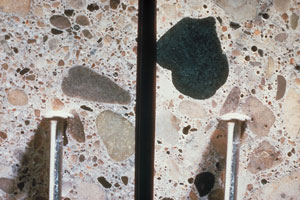 and subbase layers, the aggregate may eventually become saturated. Then with freezing and thawing cycles, cracking of the concrete starts in the saturated aggregate at the bottom of the slab and progresses upward until it reaches the wearing surface. This problem can be reduced either by selecting aggregates that perform better in freeze-thaw cycles or, where marginal aggregates must be used, by reducing the maximum particle size. Also, installation of effective drainage systems for carrying free water out from under the pavement may be helpful.
Cross section of air-entrained (right) and non-air-entrained concrete. Large size air voids are entrapped air. Small pinpoint size bubbles (entrained air) uniformly distributed through the paste are beneficial air voids. Note comparison with common pin.

Air entrainment - The severity of freeze-thaw exposure varies with different areas of the United States. Local weather records can help determine the severity of exposure. The resistance of concrete to freezing and thawing in a moist condition is significantly improved by the use of intentionally entrained air. The tiny entrained air voids act as empty chambers in the paste for the freezing and migrating water to enter, thus relieving the pressure in the pores and preventing damage to the concrete. Concrete with a low permeability (that is, a low water-cement ratio and adequate curing) is better able to resist freeze-thaw cycles. In rare cases, air-void clustering can occur, leading to a loss of compressive strength. More on air-void clustering.

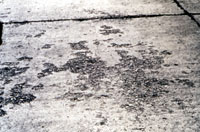
Typical example of scaled concrete surface
Prevention of Concrete Scaling
Scaling is defined as a general loss of surface mortar or mortar surrounding the coarse aggregate particles on a concrete surface. This problem is typically caused by the expansion of water due to freezing and thawing cycles and the use of deicing chemicals; however properly specified, produced, finished, and cured quality concrete need not suffer this type of deterioration. There is a distinct chain of responsibility for the production of scale resistant concrete.
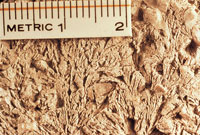 Closeup view of ice impressions in paste of frozen fresh concrete. The ice crystal formations occur as unhardened concrete freezes.
Freezing temperatures. Concrete gains very little strength at low temperatures. Accordingly, freshly placed concrete must be protected against freezing until the degree of saturation of the concrete has been sufficiently reduced by cement hydration. The time at which this reduction is accomplished corresponds roughly to the time required for the concrete to attain a compressive strength of 500 psi. Concrete to be exposed to deicers should attain a strength of 4,000 psi prior to repeated cycles of freezing and thawing.
 Optimizing the Use of Fly Ash in Concrete Cold weather and winter conditions can be challenging when concrete contains fly ash. Especially when used at higher levels, fly ash concrete typically has extended setting times and slow strength gain, leading to low early-age strengths and delays in rate of construction. In addition, concretes containing fly ash are often reported to be more susceptible to surface scaling when exposed to deicing chemicals than portland cement concrete. It is therefore important to know how to adjust the amount of fly ash to minimize the drawbacks, while maximizing the benefits.
The architect for the Bayview high-rise apartment optimized the amount of fly ash on the basis of the requirements of the concrete specification, the construction schedule and the temperature. He limited the amount of fly ash in slabs on grade placed during winter months to 20 percent. If adequate curing cannot be provided or if the concrete is exposed to freezing and thawing in the presence of deicer salts, the amount of fly ash should always be less than 25 percent. More on optimizing the use of fly ash in concrete.
Publications
Different concretes require different degrees of durability depending on the exposure environment and the properties desired. The Specifer’s Guide to Durable Concrete, EB221, is intended to provide sufficient information to allow the practitioner to select materials and mix design parameters to achieve durable concrete in a variety of environments.
Optimizing the Use of Fly Ash in Concrete discusses issues related to using low to very high levels of fly ash in concrete and provides guidance for the use of fly ash without compromising the construction process or the quality of the finished product. Case studies were selected as examples of some of the more demanding applications of fly ash concrete for ASR mitigation, chloride resistance, and green building.