Although prestressed concrete was patented by a San Francisco engineer in 1886, it did not emerge as an accepted building material until a half-century later. The shortage of steel in Europe after World War II coupled with technological advancements in high-strength concrete and steel made prestressed concrete the building material of choice during European post-war reconstruction. North America's first prestressed concrete structure, the Walnut Lane Memorial Bridge in Philadelphia, Pennsylvania, however, was not completed until 1951.
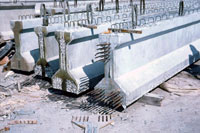 In conventional reinforced concrete, the high tensile strength of steel is combined with concrete's great compressive strength to form a structural material that is strong in both compression and tension. The principle behind prestressed concrete is that compressive stresses induced by high-strength steel tendons in a concrete member before loads are applied will balance the tensile stresses imposed in the member during service.
Prestressing removes a number of design limitations conventional concrete places on span and load and permits the building of roofs, floors, bridges, and walls with longer unsupported spans. This allows architects and engineers to design and build lighter and shallower concrete structures without sacrificing strength.
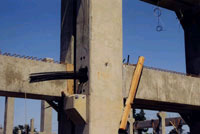 The principle behind prestressing is applied when a row of books is moved from place to place. Instead of stacking the books vertically and carrying them, the books may be moved in a horizontal position by applying pressure to the books at the end of the row. When sufficient pressure is applied, compressive stresses are induced throughout the entire row, and the whole row can be lifted and carried horizontally at once.
Compressive Strength Added
Compressive stresses are induced in prestressed concrete either by pretensioning or post-tensioning the steel reinforcement.
In pretensioning, the steel is stretched before the concrete is placed. High-strength steel tendons are placed between two abutments and stretched to 70 to 80 percent of their ultimate strength. Concrete is poured into molds around the tendons and allowed to cure. Once the concrete reaches the required strength, the stretching forces are released. As the steel reacts to regain its original length, the tensile stresses are translated into a compressive stress in the concrete. Typical products for pretensioned concrete are roof slabs, piles, poles, bridge girders, wall panels, and railroad ties.
In post-tensioning, the steel is stretched after the concrete hardens. Concrete is cast around, but not in contact with unstretched steel. In many cases, ducts are formed in the concrete unit using thin walled steel forms. Once the concrete has hardened to the required strength, the steel tendons are inserted and stretched against the ends of the unit and anchored off externally, placing the concrete into compression. Post-tensioned concrete is used for cast-in-place concrete and for bridges, large girders, floor slabs, shells, roofs, and pavements.
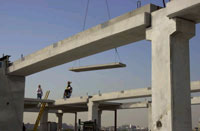 Prestressed concrete has experienced greatest growth in the field of commercial buildings. For buildings such as shopping centers, prestressed concrete is an ideal choice because it provides the span length necessary for flexibility and alteration of the internal structure. Prestressed concrete is also used in school auditoriums, gymnasiums, and cafeterias because of its acoustical properties and its ability to provide long, open spaces. One of the most widespread uses of prestressed concrete is parking garages.
For more information on prestressed concrete,
click here.