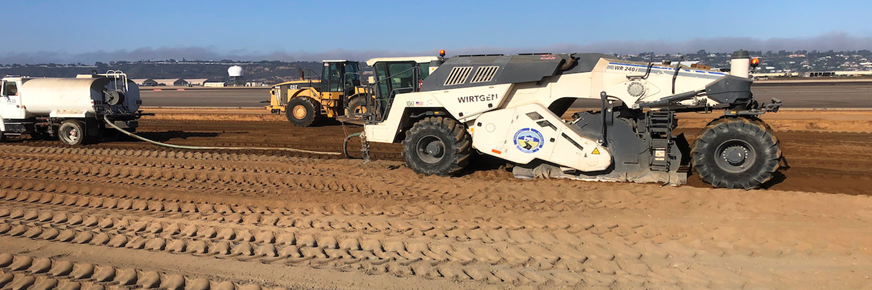
Soil-cement (SC) is an engineered, densely compacted mixture of soil/aggregate, portland or blended cement, other cementitious materials (possibly), and water. SC is known by a variety of names including cement-stabilized base, cement-treated aggregate base, cement-treated soil, and even dirtcrete. Regardless of what it is called, the principles governing its composition and construction are the same. There are a wide variety of applications of SC, and all have the common advantages of using SC. On-site soils are amended to achieve the desired physical properties to build long-lasting structures that are economical and have a low environmental impact over their life span.
Applications
SC is used in numerous construction applications for pavements, water resources, and geotechnical projects.
Pavements applications include:
- Base courses for streets, roads, highways, shoulders, airports, and parking and storage areas
- Subbase courses for rigid pavements
- Modification or stabilization of subgrade soils
Water resources applications include:
- Slope protection for embankment dams, levees, and streambanks
- Liners for impoundments and channels
- In-stream grade control structures
Geotechnical applications include:
- Modification or stabilization of foundation soils
- Slurry cutoff walls
- Deep mixing methods
Engineering Properties
There are four major variables that control the engineering properties of SC materials:
- the characteristics of the soil
- the proportion of cement in the mix
- moisture conditions (water content)
- the degree of compaction
The “soil” material in SC can be almost any combination of sand, silt, clay, gravel, or crushed stone. Local granular materials, such as slag, caliche, limerock, and scoria, plus a wide variety of waste materials including cinders, fly ash, foundry sands, and screenings from quarries and gravel pits, can all be utilized as soil material. The PCA Soil Primer has basic information on soils regarding their influence on the design, construction, and performance of SC as well as considerable information on soil survey and sampling methods.
It is possible, simply by varying the cement content, to produce SC mixtures ranging from those which result in only modification of soils to those which result in hardened soil materials that meet durability and strength requirements.
The objective of cement-modified mixtures is to amend the undesirable properties of problem soils so that they are suitable for use in construction. The plasticity and volume-change capacity of the soil is reduced, and its bearing value increased.
Cement-stabilized mixtures are hardened materials which satisfy established strength requirements. Certain agency protocols may also be used to further define a cement-stabilized design such as standard freeze-thaw and wet-dry durability tests.
Since SC is a structural material, it possesses engineering properties of a magnitude dependent primarily on type of soil, cement content, degree of compaction/consolidation, curing conditions, and age.
For pavements and geotechnical applications, the 7-day unconfined compressive strength (UCS) of saturated specimens at the minimum cement content meeting SC criteria can range from 100 psi (0.7 MPa) up to 800 psi (5.5 MPa) depending on the soil. Cement-modified mixtures typically do not result in any measurable UCS as the intent is to only reduce the soil’s moisture content or plasticity. Cement-stabilized mixtures for subgrades and foundations are between 100 and 300 psi (0.7 MPa and 2.1 MPa), and between 300 and 800 psi (2.1 and 5.5 MPa) for pavement bases and subbases. For more information, see the PCA Guide to Cement-Based Integrated Pavement Solutions.
For water resources applications, the 7-day UCS of saturated specimens at the minimum cement content that produces adequately hardened SC will generally be between 300 and 800 psi (2.1 and 5.5 MPa). No direct relationships exist between UCS and erosion resistance due to flowing water or wave action. However, specifications for SC used in water resources applications typically have required minimum in-place 7-day UCS between 600 and 750 psi (4.1 and 5.2 MPa). For liners, the strength requirements can be as low as 500 psi (3.4 MPa), for grade control structures 1,000 psi (6.9 MPa), and for spillways up to 2,000 psi (13.8 MPa). The exact strength requirements should be based on climate conditions, abrasion requirements, frequency of use, and bedload sediment transport conditions. For more information, see the PCA Soil-Cement Guide for Water Resources Applications.
Laboratory Tests
One of the key factors that accounts for the successful use of SC in pavements, water resources, and geotechnical applications is the careful predetermination of engineering control factors in the laboratory and their application during construction. Because the composition of soils varies considerably, before any construction begins, the soil that will be treated with cement should be identified and representative samples of each type forwarded to a geotechnical laboratory for testing. These variations in soils affect the way they react when combined with portland or blended cement and water.
The way a soil reacts with cement is determined by simple laboratory tests made on mixtures of soil combined with cement. These tests, which state highway agencies and most commercial geotechnical testing laboratories are equipped to run, determine the three fundamental requirements for SC:
- the minimum cement content required to produce the desired SC product in terms of UCS and durability requirements,
- the optimum moisture content necessary to sufficiently compact the SC, and
- the maximum dry density to which the SC must be compacted during construction.
Established and current test methods from ASTM International (ASTM) and the American Association of State Highway and Transportation Officials (AASHTO) are used to determine these factors. A summary of the more common ASTM and AASHTO specifications and test methods used in SC construction is as follows:
- ASTM C136 / AASHTO T 27 - Sieve Analysis of Fine and Coarse Aggregates
- ASTM C150 / AASHTO M 85 - Portland Cement
- ASTM C595 / AASHTO M 240 - Blended Hydraulic Cements
- ASTM C1157 - Performance Specification for Hydraulic Cement
- ASTM C1580 / AASHTO T 290 - Water-Soluble Sulfate in Soil
- ASTM C1602 - Mixing Water Used in the Production of Hydraulic Cement Concrete
- ASTM D558 / AASHTO T 134 - Moisture-Density (Unit Weight) Relations of Soil-Cement Mixtures
- ASTM D559 / AASHTO T 135 - Wetting and Drying Compacted Soil-Cement Mixtures
- ASTM D560 / AASHTO T 136 - Freezing and Thawing Compacted Soil-Cement Mixtures
- ASTM D1633 - Compressive Strength of Molded Soil-Cement Cylinders
- ASTM D4318 / AASHTO T 90 - Liquid Limit, Plastic Limit, and Plasticity Index of Soils
- ASTM D6913 / AASHTO T 88 - Particle-Size Distribution (Gradation) of Soils Using Sieve Analysis
Preconstruction planning, sampling, and testing is imperative because as invaluable as these standards are, they often require considerable time to obtain the factors needed for construction. For more detailed information about specific testing procedures, refer to the PCA Soil-Cement Laboratory Handbook.
Before any actual SC construction begins, these simple laboratory tests establish the cement content, compaction, and water requirements of the soil material to be used. During construction, field tests are made to see that these laboratory requirements are being met. Field testing ensures that the mixture will have strength and long-term durability. No guesswork is involved.
General Construction Procedures
SC for pavements, water resources, and geotechnical projects can be either mixed in place or in a central mixing plant close to the project site. Central mixing plants can be used where borrow material or blends of material are involved. Friable granular materials are selected for their low cement requirements and ease of handling and mixing. Pugmill-type mixers are normally used due to their speed, mixing efficiency, and continuous production. The mixed SC is then transported to the jobsite in dump trucks and spread on the prepared subgrade, subbase, or embankment. Compaction and curing procedures are the same for central-plant and mixed-in-place procedures.
In SC construction the objective is to obtain a thoroughly mixed, adequately compacted, and cured material. Construction methods are simple and follow a definite five-step procedure:
- Preparing
- Shape the area to the required plan elevations (crown, grade, slope, etc.)
- Correct any unstable subgrade, subbase, or embankment areas
- If necessary, scarify, pulverize, pre-wet the soil, and reshape to plan elevations
- Processing
- Mixed-in-place method
- Distribute portland or blended cement (either dry or slurry) and mix
- Apply water and remix
- Central mixing plant
- Mix soil, portland or blended cement, and water
- Haul mixed SC to placement area
- Spread SC uniformly over placement area
- Compacting
- Finishing
- Curing
Most SC is built from materials that require little or no preliminary pulverizing. If pulverization is required, it is usually done the day before actual processing. Processing operations are continuous and should be completed the same working day.
The construction of SC is largely accomplished using a variety of common roadway and sitework machinery. Equipment used in SC construction will vary from contractor to contractor depending on the project, but the basic equipment needed is as follows:
- Soil mixer/reclaimer
- Motor grader
- Dry cement spreader or slurry spreader/distributor truck
- Water truck
- Compaction equipment
- Tamping/sheepsfoot/padfoot roller (for clayey and silty material)
- Smooth drum roller (for granular soils)
- Pneumatic tire roller (optional)
For stabilized SC, when properly mixed with the correct cement content and compacted to its maximum dry density, the mixture is bonded permanently, and the hardened SC will not deform or consolidate further under loading. Curing, the final step, prevents evaporation of water to ensure maximum strength development through cement hydration. Contractors bidding on SC projects know that construction will be relatively easy and problem-free; weather delays rare; and reworking of completed sections unnecessary.
The purpose of field inspection and control of SC during construction - cement content, moisture content, mixing, compaction, and curing - is to ensure that the results set out in the plans and specifications are obtained and if problems do arise they can be handled immediately. A complete description of inspection steps and appropriate tables and charts for use by the inspector are given in the
.
PCA’s Research and Technology Department is staffed with engineers experienced in the use of cement-specific materials for a wide variety of infrastructure applications, and they are available to answer your questions. Learn more about their expertise and how to contact them here: