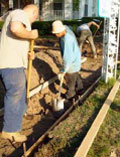
 1. Remove all vegetation, soft soils, and rocks so that support for the slab is uniform. If possible, place concrete on undisturbed, firm soil.
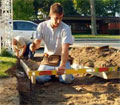 2. Set forms so that the concrete slab surface slopes a minimum of two percent, or 1/4 inch per foot, to provide adequate drainage.
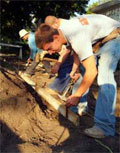 3. Use a scratch template, typically, a piece of 2-by-4 or 2-by-6 lumber equal to the specified slab thickness with stakes attached to the top surface at each end, or a string line across the top of the forms to ensure proper slab thickness.
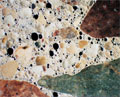 4. Order air-entrained concrete if the flatwork will be exposed to
freezing and thawing and deicing chemicals. The total air content should be five to eight percent for concrete with a maximum size aggregate of 3/4 to one inch). Do not hard-trowel air-entrained concrete.
5. Specify a minimum cementitious material content in relation to the maximum aggregate size as shown in Table 1, to ensure good finishability of the fresh concrete and good durability of the hardened concrete.
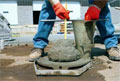 6. Do not use high-slump concrete. Control water additions at the truck. A good slump for most flatwork placed by hand: five inches. For slabs struck off with mechanical equipment: two to four inches. Even high slump caused by admixtures can be detrimental as the paste content (and shrinkage) of the upper portion of the slab can be greater than the lower portion of the slab — leading to increased warping.
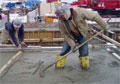 7. Never allow wet concrete to saturate clothing, enter boots, or to stay in contact with the skin while placing or finishing concrete.
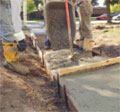 8. Strike off the surface while keeping a small amount of concrete in front of the straightedge to fill in low spots. This helps to prevent birdbaths in the finished surface.
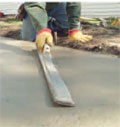 9. Bullfloat or darby the surface before the concrete begins to bleed.
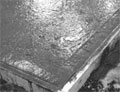 10. Do not perform any finishing operation while bleed water is present on the surface. Do not dust dry cement on the surface to soak up bleed water.
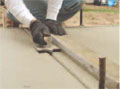 11. Use a groover to make contraction joints in the fresh concrete. Make sure the groove depth is one-fourth of the slab thickness. As an option, saw the joints using either an early-cut saw or a conventional saw. Early jointing helps prevent cracking.
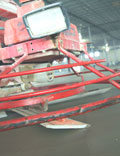 12. Do not steel trowel concrete that contains more than 3 percent entrained air. Hard troweling of air-entrained concrete may cause surface deterioration.
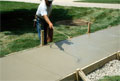
13. Start
curing the concrete immediately after completion of finishing operations.
 14. In areas with freezing and thawing cycles, if concrete is placed late in the fall, use wet-curing methods rather than membrane forming curing compounds. This will allow the concrete to dry before the first freeze. In any case, inform the owner not to use deicing agents during the first winter.
For More Information
See the American Society of Concrete Contractors (ASCC)
Concrete Finishing Training DVD.